Wednesday, August 11, 2010

July 10 Firing

With a bit more care, some great advice and a change in glazing method, I'm pretty happy with yesterday's glaze firing.

I think its helping me to fill in the dead spaces around my ware with kiln posts to create and hold more heat and I think it maybe creates little micro-atmospheres in the kiln in reduction.
So that's what I've taken to doing.

Ron Roy gave me some valuable insight into crawling, and I took it to heart, doing a more thorough soaking at about 1800f to burn out impurities in the clay - especially important since I'm single-firing.

Lastly, I cleaned up an old sprayer and had a go at spraying glazes.
Besides the obvious benefits of even coverage and blending, I can see right away that its a great way to glaze greenware. Much less stress to the delicate pots!
So I bought a gravity feed sprayer from Harbor Freight and will be constructing a spray booth from a RubberMaid garbage can today.
With these minor breakthroughs, maybe I'll even learn to love glazing...

Note:
Cone 10 redux - single fire.
Soaked @ 500f for 1 hour, again at 1800f for an hour (per Ron Roy's suggestion) and held at the top, in heavy reduction for 45 minutes.


Moon Plate


So...
this plate is about 12" on a side.
Slabbed plate with thrown foot.
Its a white body, into which I squished bits of scrap from a dark body (probably trimming leavings from a bowl or something) which explains the halos on the plate's surface - the glaze (Lasse Ostman's Green Crackle) looks very different on a dark body than on a light one, and different again in reduction.


The glaze was sprayed on!
That's something I'm experimenting with and so far I LOVE the results!


Chachke Holders


Little Chachke Holders.
Just playing around - these would make good little test tiles. They're about 2: on a side.
Stronthium Blue glaze, dipped.


Noodle Bowl


I made this for an Empty Bowls event happening in my community.

Glaze (Melinda's "Not Yellow") is sprayed on, though not thickly enough, so I need to re-glaze I think.

Dark body with white slip inside. Same glaze over the entire piece. The textured band has an iron oxide wash.

I like it, but it needs better glaze coverage. 
Something to learn about spraying...


Butter Tray


My little butter tray.
Well, this was sure fun to make!
I really like how it turned out, with one minor flaw...its not supposed to sag like this LOL!

This is a white body.
Iron oxide washed on and removed and then sprayed with Lasse Ostman's Green Crackle.
Fired on the top shelf, so less reduction that the other pieces.


Hors Devours Plates


Each is about 4: on a side.
I know they were utterly flat when I put them in the kiln, but each has warped slightly.
Anyone have any thoughts on that?
The glaze is Melinda's "Not Yellow" and though I'm getting different results than she, I just love this glaze!
Here its brushed onto the dark body fairly thickly.


So, you all know the drill... feedback's happily accepted - constructive critique is even better!
Thanks for looking...
CMCK

Friday, August 6, 2010

16 Glazes, 80 Test Tiles!

Glazing is truly my weak point at this time.
I have a terrible time getting predictable results of late.
So I bit the bullet and did a whole lot of testing, with a mixed bag of results.
Please to enjoy...


Notes:
This was a cone 10/11 reduction firing.
My kiln is a small (3.5 cubic feet) electric, converted to a propane updraft. I did some experimenting with the load as well as the glazes...

On the bottom shelf, I posted around the edge of the round shelf, using 8 posts.
On the middle shelf, I places posts on their sides, 2 rows tall, creating a sort of saggar around the tiles, with just enough opening in the "enclosure" for the cone pack
The topmost shelf was covered with a shelf posted with just 4 posts, and then a baffle shelf was placed on that about 3" under the flue opening.

This was a single-fire load, on bone dry greenware -  I used 2 clay bodies - a high iron, groggy clay (Sandstone Buff from Quyle Kilns) and a white/gray body (SilverStone, also from Quyle).

For each glaze, 5 tiles were used - 2 of the dark body and 2 of the light body were dipped either 1/2 or 2/3, with 1 tile of each body being placed on the middle and top shelves.
A 5th tile of the combined bodies was glazed, with washes of red iron oxide and rutile brushed on both under and over the glaze. All the washed tiles were placed on the lowermost shelf.

The "saggared" shelf (the middle shelf) had much more reduction, which is noticeable in the bare clay at the bottom of each tile.
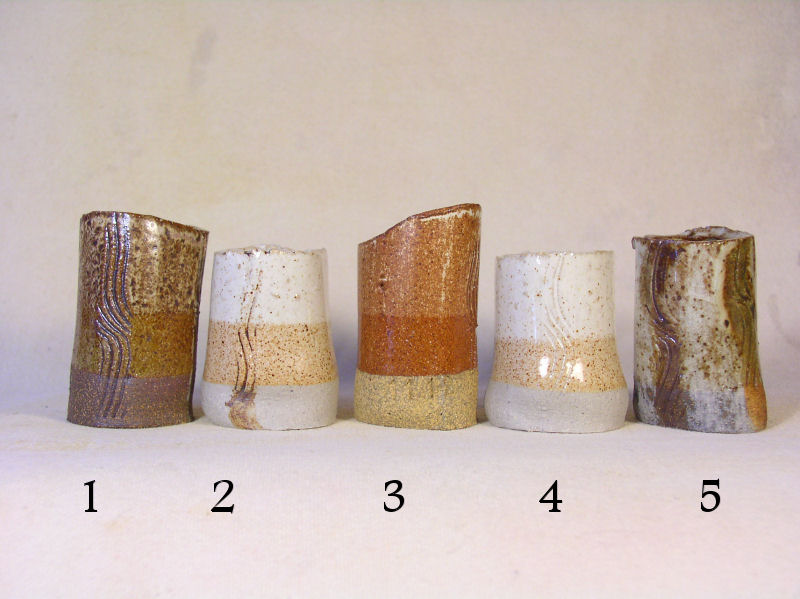
The tiles are numbered:
1= dark body on middle shelf. 2= light body on middle shelf. 3= dark body on top shelf. 4= light body on top shelf. 5 mixed body with RIO and Rutile washed over and under, on bottom shelf.
Click on images to enlarge.
whew!


Shaner Yellow


  • Custer...............29
  • Whiting.............20
  • Talc.....................4
  • Bone Ash............4
  • Zircopax............23
  • Red iron oxide.....4


Notes:
These were all dipped 1/2.
Has significant crawling on the dark body, but none on the light body.
Wonder why...


Melinda's Not Yellow

  • Neph Sye..........58.1
  • Dolomite...........19.3
  • Ball Clay.............3.9
  • Bentonite.............7.3
  • Zircopax............11.4
  • Tin Oxide..........2.1
  • Red iron oxide...0.5
Notes:
These were all dipped 1/2.
Melinda gets lovely blues and creams, breaking to rust.
She says this glaze is best with an RIO wash underneath, and better on bisqued  clay.
I didn't have any Tin Oxide, so I subbed more Zircopax.


Candace Black

  • F-4 Feldspar..........65
  • Whiting.....................5
  • Silica......................20
  • Kaolin......................5
  • Red iron oxide..........8
  • Colbalt carbonate.....5
Notes:
Just fail.
From "Complete Guide to High-Fire Glazes", by John Britt. All dipped 1/2.
First (and perhaps most importantly), I didn't have F-4 feldspar, so I used Custer.
Still searching for a nice black...


Snow White


  • Hawthorne Bond.....30
  • Custer.....................10
  • Silica.......................30
  • Oak woodash.........25
  • Zircopax...................6
Notes:
All were dipped 1/2.
Formulated playing around on GlazeSimulator.com .

Just not very pretty.
The glaze called for Tin oxide, so I added Zircopax at twice the amount. Again, crawling on the dark body, but not on the light. The dark body has much more tooth. 


Orange Peel


  • KMS Kaolin.....20
  • Custer.....31
  • Talc.....34
  • Silica.....15
  • Copper carbonate.....0.05
  • Copper oxide.....0.05
Notes:
Dipped 1/2. Again, playing with GlazeSimulator.com . This one has potential I think. Its satiny and touchable. I like what its doing over the Rutile wash. I think I might either sub Rutile for the coppers or just add it in. Might also try an addition/substitution of Chromium oxide.


Coleman Tea Dust

  • Custer.................40
  • Silica...................25
  • Whiting................16
  • Talc.......................7
  • Red iron oxide.....10
Notes:
Dipped 1/2, should have defloculated a bit and dipped 2/3 I think.
First, I didn't do a slow cool-down in this firing, so I didn't get any crystallization, but I knew that would be the case.
I really like how it reacts both over and under the Rutile.
Its a keeper...


No-Barium Blue

  • Strontium................31.9
  • Neph sye................53.1
  • Ball clay....................6.7
  • Silica.........................8.3
  • Copper carbonate.....4.0
  • Bentonite...................1
  • Zircopax..................10
Notes
1/2 dipped. From the article "Leaving Bariumville" on CeramicsArtsDaily.org .

The original recipe looked lovely on porcelain, but not so good on my clays. I didn't like the translucent quality, so I added the Zircopax for opacity. I like it much better now, and actually prefer it on the dark body.

Don't think it works with any of the washes.


Bone Ash white

  • NC-4 Feldspar.....40
  • Kaolin.....25
  • Dolomite.....30
  • Bone Ash.....5
  • Bentonite.....3 
Notes:
From the book "Complete Guide to High-Fire Glazes" by John Britt.

#1 & #2 - single dipped. #3 & #4 twice dipped. #5 single dipped.

I didn't have NC-4 Feldspar, so used Custer. I really like this on tile #4, though it crazed a fair amount.


Haynes White

  • Neph Sye.....45
  • Silica.....30
  • Whiting.....8
  • Dolomite.....10
  • Talc.....7
  • Bentonite.....1
Notes:
Dipped once, glaze was a cream consistency. From the book "Complete Guide to High-Fire Glazes" by John Britt.

Well...Its essentially a clear glaze.
It has something of a chun quality to it, and as you can see, is very different in heavier reduction.
Anxious to see it in an Oxidation firing.
I really like the life it has both over and under RIO,


Ostman's green Crackle


  • Neph sye...............55
  • Dolomite................23
  • China clay..............21
  • Silica........................1.25
  • Copper carbonate....0.75
Notes:
Dipped 2/3. From Lasse Ostman's glaze page.

When Mr Ostman uses this glaze, thinly, on a white body, in oxidation, he gets a lovely matte green crackle,

I wish you could feel this glaze and see it in person. Its so alive...I love ll its incarnations.
You can't tell here, but that red on tile #5  is crystal formation - perhaps encouraged by the RIO wash...


Gary's Gold


  • Dolomite.............21.02
  • Whiting...............10.51
  • Custer.................36.84
  • Silica...................31.63
  • Bentonite...............5.3
  • Ritile....................10.51
  • Red iron oxide.....10
Notes:
Dipped 1/2. From Gary Kelsey, Trenton, Mo.

One of my favorite, most consistent glazes. I just love it. More crystals on an iron rich body, but nice either way. Not really effected by either of the washes, but a dip of Celedon over it produces great effects.


Ohata Red


Notes:
Dipped 1/2 - best with 1 thin dip.
Shoot! Can't find my recipe right now.
I don't really like this glaze on its own, but under ash glazes it does crazy-wonderful oil-spotty type things.
tile #5 is showing over and under Rutile.


3/3/3 chrome Ash


  • Redart.....33.3
  • Silica...33.3
  • Wood ash...33.3
  • Chromium oxide...4
  • Bentonite....1
Notes:
1/2 dip. I was just playing around...so while I'm sure others have made this same glaze, its just out of my head.

I've mixed it up with Rutile, Copper oxide and with no oxides. I like it because it doesn't run, and has a lot of life to it.
I don't use it inside functional ware.
Tile #5 shows it under Rutile.


333 Chrome Ash Over Rutile


Notes
Half of each tile (vertically) is washed
 inside and out with Rutile. 
You can see the difference I think.

I find the more texture a piece has, the more interesting it is.


Well, that's all I have.
I always get such good feedback from fellow potters when I post here, and I'm pretty anxious to hear everyone's thoughts.

I'll be doing another test next week  same process, but in an oxidation atmosphere.
Looking forward to that!
thanks for taking a look!
CMCK


Monday, July 19, 2010

Updates and Doings

Its Been a While - Deadlines!
Share
Geeze - haven't updated in some time!
The heat has really drained me of any artistic gumption at all, but I do have some looming deadlines, so I must get crackin'.

Mosaic Project


I'm working on an address post mosaic for my brother and sister-in-law. Their birthdays are next week, so I gotta get this done! Its not as large as the last one i made, but I'm using much smaller pieces of tile, so its more labor intensive.
Not sure whether to use a dark grout or a light one.


Last Glaze Firing


I was pretty discouraged with my last firing - none of my test glazes worked well, and I just unloaded a kiln full of ugly. This blue needs some work. Its from an article in Ceramics Monthly about subbing Stronthium for Barium. I think I may need to add some Zircopax or Tin Ox to it and opacify it a bit. Maybe a little less Copper Carbonate too.

The bird feeders don't look so hot, but they function well, so at least I've managed to get a good design down. The Bug Jugs need some refinement. The feet are just too intricate for efficient waxing/glazing, so I need to simplify them. Trying out a glaze Melinda shared with me, and had some problems with it crawling, but I was telling Jeff about my glazing issues and how glazes are formulated. I mentioned that I use a postal scale to measure my ingredients and he thought that was probably a large part of the problem, so he bought me a nice new gram scale!

Mi Casa Project


The tiles glazed pretty well. I had initially put a black slip over them and bisqued them.
For the glaze firing, I added some oxide washes and glaze highlights and then put a simple clear glaze over the whole thing and then wiped away much of it. I was pretty happy with the result, but one of the tiles was cracked during glazing and so the piece was not going to work for theHands in Clay show next month.

Rather than try and make a replacement tile, I decided to take the idea in another direction and came up with this plate. its a slab plate with a thrown foot. I inlaid colored slips into the textured background and then sprigged the figures on top of that. It has all the life and chaos I had wanted, though I did have to omit the goat :(.

I also made some test tiles so I can be absolutely sure of my technique before I glaze the plate. They are firing tomorrow, with a variety of treatments. I'm most hopeful that using a dark Tenmoku wash instead of the black slip will work.

So I am loading a glaze/test tile kiln load today and hopefully firing tomorrow (wind and heat permitting).
If I like the results, I'll fire the plate later this week and if I'm happy with it, I'll deliver it to Modesto on the 30th.

Calaveras Arts Council Studio tour


Ack!
The last couple years Jeff and I have gone on this great, self guided tour of local art studios.
This year I joined the Calaveras Arts Council, and the San Joaquin Potters' Guild.
I've signed up to participate in the Calaveras Arts Council Studio Tour at the end of September.
I'll be showing up at Quyle Kilns (I hope) as my studio is too small and too remote to be practical on its own.

That means I have to get into production mode in August!
Son after that, I think both groups will be gearing up for holiday gallery sales, so I need to be thinking about that too!

Sketch Book Project


I started taking ceramics as a distraction from my other art classes in college.
For most of my life I considered myself a 2D artist and focused on drawing, painting and printmaking.
Recently I learned about something called the The Sketchbook Project put on by the ArtHouse Co-op.

They send you a little sketchbook, and you have till January to fill it and send it back to them where it becomes a permanent part of a traveling exhibit.
I chose the theme "Face in the Crowd", as I want to do some studies of my goat herd.
Its been a long time since I've picked up a Turquoise #b1...

Collaboration!


Lastly (whew!) my former Stay-at-Home mug exchange partner and FaceBook friend Sabra Wood has proposed a cross-country collaboration! We enjoy each other's art very much, and she suggested we find a way to collaborate and develop an item together.

I love the idea and can hardly wait to get started. Gotta clear out a few of these other things and then we'll see what we can come up with.
I've anchored a blog for us so when we get started we can keep track of our progress.

The only other thing I need to do is take new pics of my Etsy pieces. I haven't made a sale in a while and need to promote my stuff more.

The KC Clay Guild show has closed. I have not received either my tea bowl or a check, so I don't know if it sold or not. I'll give it till Aug first before I inquire about it.

So, that's the big ol' update from the Mother Lode.
I'll post again after this test firing.

Monday, June 7, 2010

Cracking Up!

Well...
Went to bed last night very happy with my newly redesigned bird feeders, only to wake to this:

These are thrown in one piece.
I have been covering them loosely, but took the plastic of last night because it was pretty humid here and they seemed to be pretty even in terms of moisture/dryness.

I dry them on this plastic grid (its a panel meant to cover an in-ceiling fluorescent light fixture) to get a little air flow all around the piece.

You can see that the one next to it has cracked all around just under the rim.
A third one has not cracked at all (knock wood).

Wondering if this is primarily a drying issue, or a compression issue. If its a drying issue, I'm wondering how better to dry these, and will I have the same challenge when I glaze them or fire them (I typically single fire to cone 10).

If its an issue with my throwing, I'm wondering if there is something I should be doing such as making the "plate" part thicker, compressing differently etc.
I typically run a wire under the piece after throwing but leave it on the bat till its leather hard.

Thanks Clay Gurus, for any thoughts!

Thursday, May 13, 2010

Latest Firing

Ok!
Lots of stuff in this load. I wanted to make a bunch of lint feeders so I have a good supply. Lower left are the shakers I made. They were featured in this month's PMI - I really like them and loved making them!

I did some glaze testing on them, and got some good and some ugly results.
The firing was to cone 11, fairly heavy reduction.

First one I tried, which I thought would be a nice white glaze for my palette was a simple Shino from Lasse Ostman.
Also from Mr Ostman's site was a Green Matte Crackle.
Lastly was Hamada Rust from John Brit's website.

Not a one turned out as expected. I also experimented with applying a white slip over my dark clay body to brighten some of the glazes. That works well!

The Good:
While Lasse Ostman's Green Matte Crackle didn't turn out at all as I had hoped, I am really liking this glaze! Its pale minty green, flashed with pinky-gray, silky and just begs to be touched. It needs to go on a white clay body (this is Laguna 1/2 stoneware/1/2 porcelain ) and may do something different in oxidation, but I don't do much ox firing. Its definitely a keeper!


The Bad:
I have never done a Shino glaze before, and don't know much about them, but I like them when I see them.
However, my attempt at Lasse Ostman's simple 3/3/3 Shino has some obvious issues.
It should have been a speckled white that breaks nicely. Instead its a greenish semi-matte without much character. Just not anything I can see using. As suggested, I applied it to my dark clay body.
Its greener than showing here BTW...


The Ugly:
John Britt makes glazes sing. I was so taken with the Hamada Rust on John's page and in his book that I wanted to try it. His examples are a deep smooth black breaking to rust. Simple, rich and classic.
I tried this on both white and dark clay bodies, with similar ugly results.
Yuck!


I am still searching for a successful Tenmoku...
I want something opaque, something that breaks nicely and something very dark.

Perhaps some of my fellow potters can offer some insight.
I wish glazing was not such a struggle for me.